
How a Hidden Asset Turned a Local Shop Into a $4 Million Empire

The most dangerous trap for a founder is having the right asset in the wrong place.
For Abby Price, the founder of Abbode, the key to a multi-million dollar business wasn't a new product launch or a venture capital check. It was a piece of equipment she already owned that was collecting dust in a basement.
Price is the 29-year-old CEO behind New York's viral embroidery brand. After generating $1.59 million in 2024, her company is on track to hit $4 million in sales this year. But her story isn't just about hard work. It is a masterclass in asset utilization and the power of pivoting when the market tells you to.
The "Vintage" Trap
In 2021, Price took advantage of pandemic-era rent deals to open a shop in Nolita with $20,000 in savings. Her initial business model was safe. She sold dried flowers and vintage home decor.
It worked well enough. During her first holiday season, monthly sales hit $60,000. But vintage retail has a ceiling. It is hard to scale unique items, and as Price noted, "There's just so much sameness" in the market.
When the holiday rush faded, revenue dropped to $45,000 a month. The business was plateauing. Price admitted she was "constantly investing" in inventory and employees while sales stagnated. She found herself crying in the store's bathroom, realizing the math wasn't adding up.
The Pivot: Asset Visibility
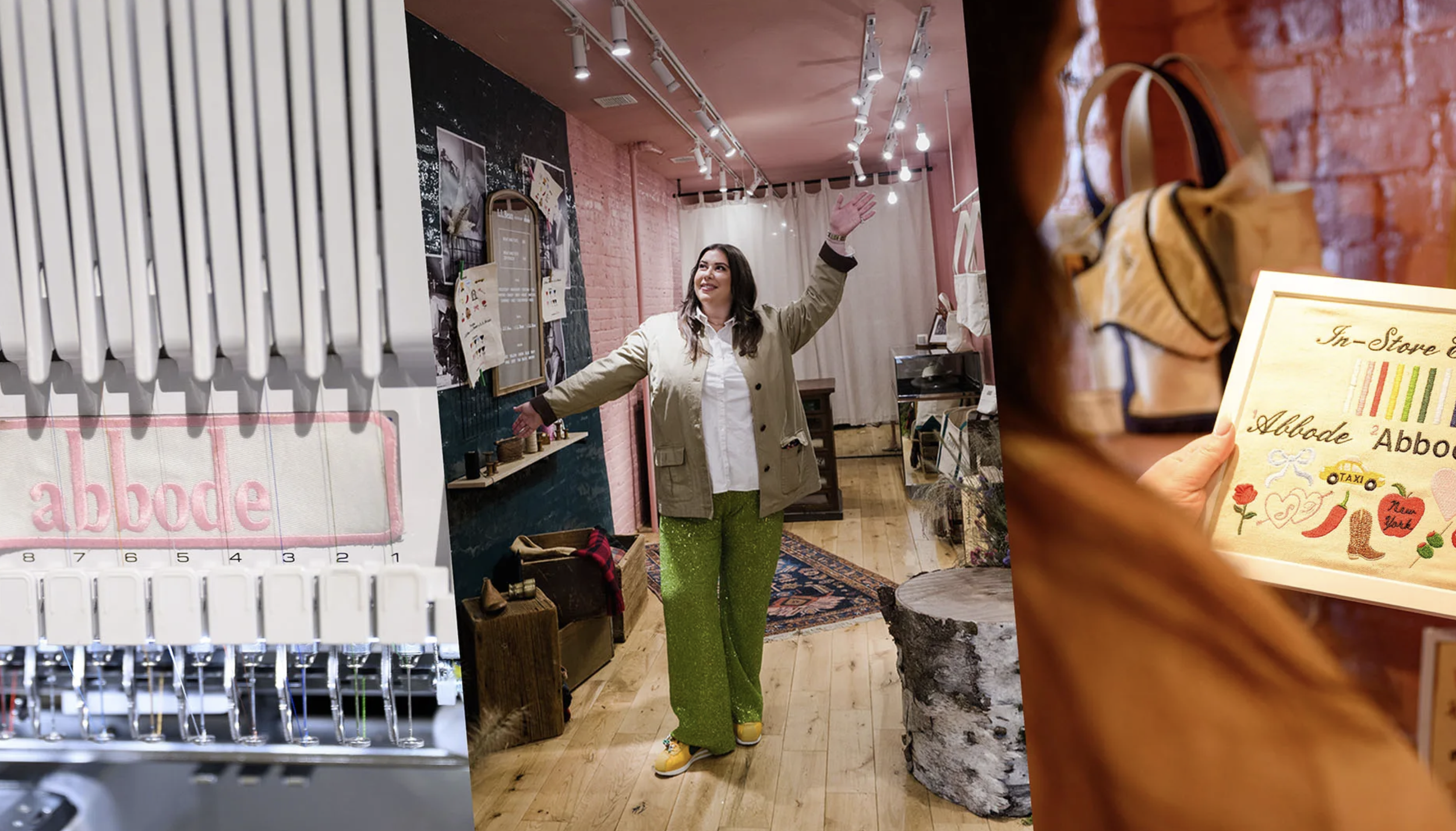
The breakthrough happened by accident. Price had purchased a $15,000 industrial embroidery machine "on a total whim" earlier in the year. Because it weighed 100 pounds and was unwieldy, she left it downstairs in the basement.
The machine was a sunk cost. It was generating zero value because it was invisible.
In March 2023, the machine needed repairs. To get it serviced, the team had to haul it upstairs to the sales floor. Her co-owner, Daniel Kwak, saw an opportunity. He suggested they leave it on the floor and lean fully into customization.
They ran a test event offering free embroidery. The results were immediate. They did five times their normal sales volume in a single day.
The Lesson: Your biggest differentiator might be hiding in your operations. By bringing the "back of house" work to the "front of house," Price turned a manufacturing process into a customer experience.
The Strategy: Breakeven Growth
Since that pivot, Abbode has transformed from a shop into a brand. Embroidery now drives the majority of the business.
What makes their strategy smart is their financial discipline. Despite projecting $4 million in sales, the business runs at breakeven. This is intentional.
Instead of taking profit out, Price and Kwak aggressively reinvest every dollar into expansion.
Capacity: They scaled to 10 machines and 25 employees.
Real Estate: They rented a second facility in Chinatown just to handle production volume.
Marketing: They focused on high-visibility partnerships with brands like L.L. Bean and Ritz Carlton.
This is the "Amazon strategy" applied to a small business. They are trading short-term profit for long-term market share.
The Future is Tactile
Price's success signals a shift in what consumers actually want. We live in a world of AI and digital interactions. People are craving "high-touch" experiences.
The data backs this up. Searches for personalized decor on platforms like Etsy are up 240%. But Abbode has an edge over online sellers. They offer the theater of creation. Customers can watch their item being made in real-time.
As Price summarizes, "We can take any ethos and emotion behind anything and turn it into embroidery."
She didn't need a new business idea. She just needed to bring her best asset up from the basement.
MORE FROM OUR BLOG:








Double-click to edit...
